Elements of Legal Malpractice
In every type of lawsuit, a plaintiff (commonly known as the person bringing the case) must make certain allegations of fact against a defendant (the[…]


Lawyers have a duty to represent their clients in a competent manner and to provide competent representation.
Much too often, however, lawyers fail their clients. Lawyers make serious mistakes or behave negligently, and their errors result in substantial harm to their clients.
If you hired an attorney who failed to represent your interests or who made a serious mistake in your case, you may be able to file a legal malpractice claim. You should speak with a West Hartford legal malpractice lawyer as soon as possible about filing a lawsuit.
At StangerLaw LLC, our Hartford, CT legal malpractice attorneys represent clients across the state of Connecticut who are victims of legal malpractice. We have extensive experience in handling legal and professional malpractice claims.
Additionally, attorney Bruce Stanger is a member of the Connecticut Bar Association’s Professional Responsibility Committee.
Our Practice is Limited to Connecticut
We handle Connecticut legal malpractice claims. We won’t review cases where financial losses are less than $100,000.
What is legal malpractice?
Legal malpractice describes a case when a lawyer fails to provide adequate representation due to a mistake or negligence. Accordingly, the lawyer’s errors or careless behavior results in damages that harm the client.
You may have heard about medical malpractice. Due to a healthcare provider’s negligence or serious error, a patient sustains injuries. This allows the patient to sue the provider for medical malpractice.
In other words, the doctor failed to live up to the medical standard of care she or he owed a patient, and the patient got hurt as a result.
Legal malpractice is similar in that it allows a client to sue a lawyer when that lawyer fails to live up to the standard of care owed to a client in a legal case. When the client suffers harm—meaning a financial injury or loss, usually—then that client may be able to file a legal malpractice lawsuit.
According to the Connecticut Supreme Court, malpractice is typically defined as:
“The failure of one rendering professional services to exercise that degree of skill and learning commonly applied under all the circumstances in the community by the average prudent reputable member of the professions with the result of injury, loss, or damage to the recipient of those services.”
We can help you determine if you have a case
What are some examples of legal malpractice in Connecticut?
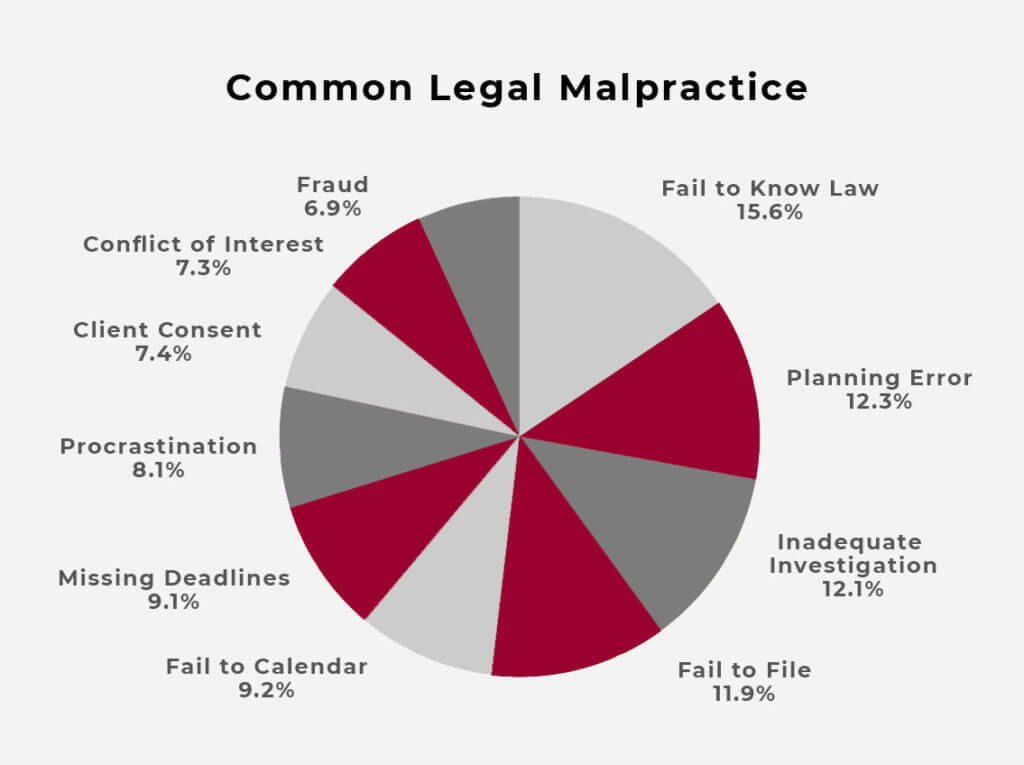
The following are some examples of negligence and mistakes made by attorneys that could result in successful legal malpractice lawsuits:
Lawyers owe a duty of care to their clients, and that duty of care means living up to a standard set by other lawyers in similar situations. Any conduct by a lawyer that deviates from the behavior that other lawyers would deem appropriate may be grounds for a legal malpractice lawsuit.
While losing a case in and of itself does not mean that a lawyer committed malpractice, there could be grounds for filing a malpractice claim if the lawyer was negligent or acted wrongfully.
There are laws in place that govern legal malpractice claims in Connecticut, as well as in other states.
The Connecticut Rules of Professional Conduct govern the lawyer-client relationship when it comes to the ethics of representation and the attorney’s duty to his or her client.
These rules require a lawyer to:
The Connecticut Rules of Professional Conduct specifically address malpractice liability, emphasizing that lawyers can be liable to clients “for the negligent rendering of services.”
However, it is important for clients who are considering filing a Connecticut legal malpractice claim to keep in mind that a lawyer’s mere breach of the Rules does not necessarily give rise to a legal malpractice claim. To be clear, the lawyer’s negligence, or breach of the Rules, must harm the patient in some way.
Please don’t hesitate to reach out to an experienced Hartford, Connecticut legal malpractice attorney today for assistance.
In 2016, Angelica N. Papastavros Esq. was sued when a client claimed ineffective assistance of counsel. Bozelko v. Papastavros, 147 A.3d 1023, 1025–26 (CT Supreme Court, 2016).
Her client was convicted for fourteen offenses and acquitted of eight others, and the client received “ten years of imprisonment, execution suspended after five years, and four years of probation.” Id.at 1026. Plaintiff claimed numerous issues such as, “ including the defendant’s alleged delay in instituting a written fee agreement, misrepresentation of the length of her legal career and criminal trial experience, [and] failure to familiarize herself adequately with the facts of the case and the relevant law and procedure…” Id. at 1026.
In this case, the Plaintiff did not succeed with her legal malpractice claim because the Plaintiff failed to provide expert testimony to establish the causation element of legal malpractice. Id. at 1032.
What does a plaintiff in Connecticut need to prove in order to be successful in a legal malpractice claim?
To show legal malpractice liability, the plaintiff needs to prove all four of these elements:
The first element of a legal malpractice claim is usually relatively easy to prove. As long as the plaintiff hired the lawyer, then there should be evidence that there was an attorney-client relationship.
Proving that an attorney committed a wrongful act or omission (meaning that the lawyer made a mistake or failed to act when she or he should have), as well as proving that the attorney’s error or omission was the proximate cause of the plaintiff’s harm, requires more evidence.
Your Connecticut legal malpractice lawyer can help build the strongest case.
Different types of legal claims have different standards of evidence.
In civil cases (those that are not criminal cases), there are generally two different evidentiary standards:
The evidentiary standard for a legal malpractice claim in Connecticut is preponderance of the evidence. As such, the plaintiff needs to show by preponderance of the evidence that the lawyer committed legal malpractice and is liable for damages.
It is extremely important to have an experienced Connecticut legal malpractice lawyer on your side to help prove your case.
If your lawyer is negligent or behaves wrongfully, what kinds of damages can you expect to receive if you file a lawsuit?
In general, the following damages may be available to plaintiffs who file a successful Connecticut legal malpractice claim:
Plaintiffs in legal malpractice cases also are eligible to receive legal fees, court costs, and attorneys’ fees.
Similar to other types of lawsuits, Connecticut legal malpractice claims have what is known as a “statute of limitations.” This is the time window that a plaintiff has from the date of the incident or her injury to file a claim for compensation.
In Connecticut, the statute of limitations for a legal malpractice claim is three (3) years. This means that a legal malpractice lawsuit must be filed within three years from the date that the claim arose. The Connecticut Supreme Court recently heard a case concerning the legal malpractice statute of limitations and emphasized that the three-year time window is a strict one for these types of cases.
If you do not file your legal malpractice claim within three years, you can be barred from seeking compensation through a lawsuit.
We have focused our practice on helping those who have been harmed by attorney misconduct. Let us help you. We can answer your questions, help you determine if you have a legal malpractice claim, and advise you on your options.
Contact us online or call (860) 561-0651 today to get the justice and compensation you deserve.
We used StangerLaw LLC for our malpractice case and found their services to be extraordinary. They worked extremely hard to get the best settlement for our case and would not accept anything less. They kept us updated and our input was always considered in their decisions. [They are] not only excellent attorneys but they truly care about their clients. – Client review Read more client testimonials…